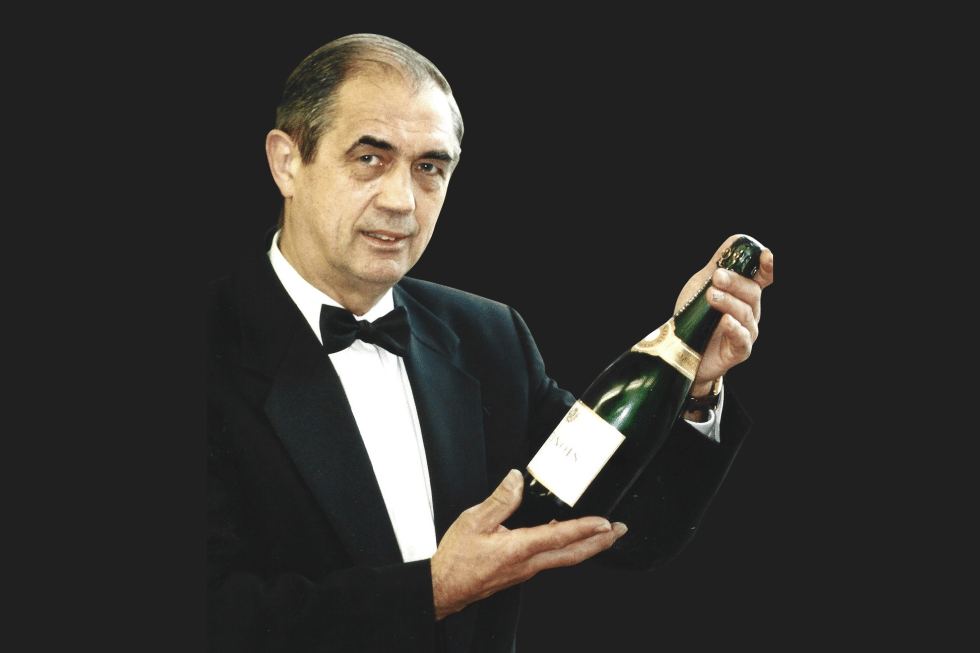
From football-mad teenager to Master Sommelier pioneer, Brian Julyan MS helped shape modern wine service while inspiring generations of wine professionals.
Brian Julyan’s interest in wine started in 1967, while on a four-year sandwich course in hospitality with City & Guilds, alternating academic study with time in industry. Julyan admits his grammar school education wasn’t entirely successful: “I was rather more interested in football than I was in academic studies.” But in the second year of the course, he started to receive lectures on wine and “all those subjects at school that I didn’t really take to, languages, chemistry, history, geography, all of a sudden, all started to make sense.” Julyan started to get interested in wine, looking forward to Tuesday afternoon lectures and the occasional tasting.
“In 1967, people didn’t really know anything about wine,” he says. Up until then, his only experience of wine had been a bottle of white wine his father had bought for Christmas, half of which was left in the bottle in the pantry. Six months later when he thought he’d sneak a taste, “It was dark brown and absolutely appalling.”
Hotels to hospitality educator
After graduating, Julyan gained experience in London and Liverpool, becoming manager of a two-star hotel at the age of 21, earning an AA Rosette for food while working in the kitchen there. Returning to Liverpool, he ran another hotel before taking up a job as a lecturer in North Wales, deciding he wanted to pass on his knowledge to others, having gained both qualifications and experience. Julyan continued to study wine, reading anything he could find on it, which at the time wasn’t much, and joined the Guild of Sommeliers. He then saw an advert for a more senior teaching job at South Devon College in Torquay, which specified ‘must have a good knowledge of wine.’
With a hotel owner on the interview board, Julyan’s experience in the industry served him well. After a couple of years, he was responsible for everything on the restaurant side of studies and ended up staying at the college for 25 years.
Asking the customer if he could check the condition as he had never tasted Petrus, he said “help yourself, just don’t take too much!”
Still a member of the Guild of Sommeliers, Julyan took an active role in helping revive the South West branch. It was there in 1970 that he first heard about the Master Sommelier Diploma, which had been introduced the previous year. In 1971 he studied hard for the exams, particularly on regions he knew little about: South Africa, USA, Australia. As he had hoped, having both the theoretical knowledge from teaching and practical experience, he passed the theory and practical parts of the exam but failed the tasting. Julyan says he “didn’t have a clue on tasting,” so Master of Wine, Joe Naughalty, who also lectured at the South West Guild of Sommeliers, agreed to teach tasting.
With his good friend Maurice Smith, Julyan tasted “wine after wine after wine.” Smith worked at the 5-star Imperial Hotel where Julyan also worked part time alongside teaching. He remembers it as the place where he decanted his first Petrus. Asking the customer if he could check the condition as he had never tasted Petrus, he said “help yourself, just don’t take too much!”
Writing the sommeliers’ handbook
In 1972, taking the tasting for the second time, Julyan passed the Master Sommelier Diploma. In 1977, the Court of Master Sommeliers was founded. “I had an idea,” he says. “I wasn’t the only founder. I wrote to the people who’d passed the exam in the UK and suggested we formed an organisation.” He received just two responses, and only one which was positive about the idea. Barrie Larvin worked with Julyan to bring the idea to life.
There was no book for those coming into the Introductory courses run by the Court of Master Sommeliers, and after a taxi ride with two students bemoaning the fact, Julyan thought he would have a go at writing one. As chief examiner for food and beverage subjects for both City & Guilds and the Hotel and Catering Institute, Julyan had plenty of information to hand and had kept up to date with the wine material.
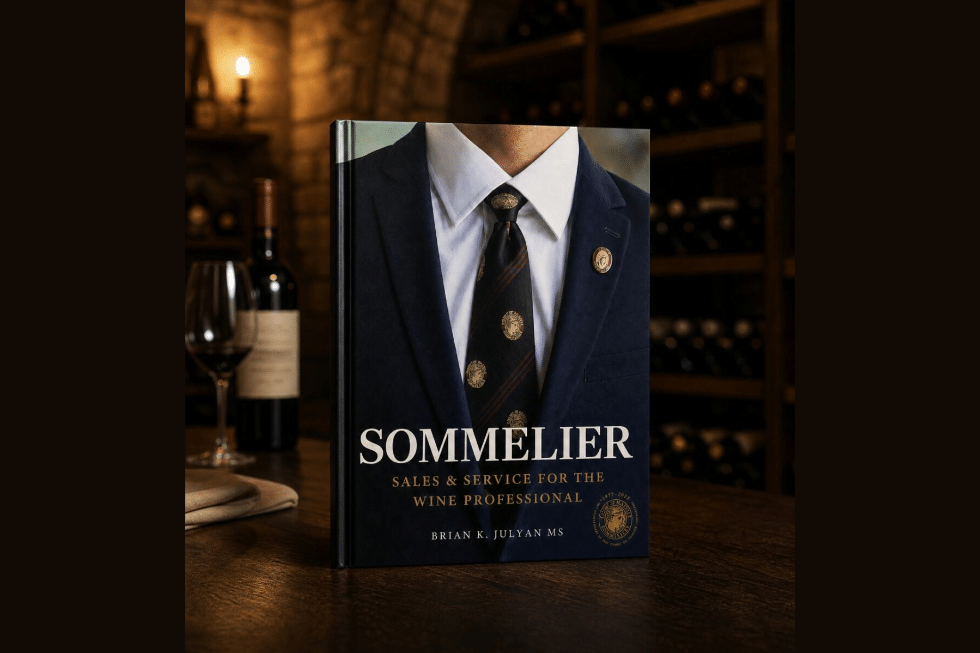
During college summer holidays, Julyan worked at an MOD army camp as Catering Manager, and started to put in extra hours to write the book: starting at 6am to receive the bakery delivery and finishing at 7pm before going back to his billet to work on the book. Over the years different editions have been published, reprinted and translated. The newest, sixth edition was published in 2026 as Sommelier: Sales and Service for the Wine Professional.
Catering for 500 people at the army camp might have had “almost nothing to do with wine” but it helped greatly when Julyan set up a degree course in Hospitality Management at the University of Plymouth. He also gained hospitality experience at Ugbrooke House, setting up the wine cellar and managing shooting weekends and events. Julyan reflects, “My career has been very bitty, varied, but all the time I’ve had this interest in drink – don’t take that the wrong way!”
The lasting legacy
“The position of sommelier really has grown in stature since the 1970s,” Julyan says, and he has advice for those starting out: Get onto the floor, make yourself indispensable, do a good job, and do the Court’s Introductory course to get a certification. For those with ambitions of becoming a Master Sommelier, a position on the floor of a good restaurant where you are handling quality wines is essential. But above all, “Study, study, study. Tasting is the fun bit, but theoretical knowledge is the basics, it’s the building blocks. So you need to get your head down.” Keeping up to date is also important, he adds, following trends and knowing what customers are drinking and what they like.
“Wine has been very good to me,” Julyan says. Judging sommelier competitions in Korea, China, and for the Chaîne des Rôtisseurs allowed him to travel the world. He notes that he always made time to visit wineries and is clear about the importance of meeting people and learning from them. Having met so many people who have had an influence on the wine industry: Dirk Niepoort, Robert Mondavi, Michel Rolland, to name but a few, he is clear that all of them taught him something. On a trip to Porto this summer as the winner of the Legend Award he met with David Guimaraens, Technical Director of the Fladgate Partnership, “and again I learnt something new.” Julyan has had a lot of opportunities to taste great wines, but if a wine fairy were to grant a wish to taste anything, his choice would be 1972 Henschke Hill of Grace, to celebrate the year he passed the Master Sommelier exam.
Over fifty years later, Julyan remains as engaged as ever with the world of wine, tasting, learning and passing on his knowledge to others. With the foundation of the Court of Master Sommeliers, “we wanted to spread the word, improve the standard, and develop sommellerie,” he says. As the 301st Master Sommelier is added to its ranks, it is clearly continuing to do just that.